
Why US Buyers Are Migrating from China to Vietnam ?
The supply chain shift from China to Vietnam is no longer a hedge. By Q1 2026, Vietnam captures 40.69% of US wooden kitchen furniture imports by value (UN Comtrade), up from 28% in 2022. For US distributors and procurement leaders, this is a structural realignment of the Asian sourcing map.
Here is what is driving it.
The Tariff Stack Reshaping China Sourcing
Three layered duties now hit Chinese imports in the furniture and cabinet segment. Each was designed independently. Stacked, they push effective rates beyond 275% on many SKUs.
Section 232 (effective October 14, 2025) added a 25% ad-valorem tariff on imported kitchen cabinets, vanities, and parts under HTSUS 9403.40.9060, 9403.60.8093, and 9403.91.0080. The scheduled escalation to 50% on January 1, 2026 was delayed to January 1, 2027 (White House Proclamation, December 31, 2025).
Anti-dumping duties on Chinese wooden cabinets reached a China-wide rate of 251.64% in the April 2026 final results (Federal Register 2026-07866).
Reciprocal tariffs add another 20% layer on Vietnamese exports under the August 2025 US-Vietnam framework, but Section 232 supersedes for cabinets and parts.
The math is simple. A Chinese cabinet shipment faces ~275% combined duties. A Vietnamese shipment faces 25%. For most buyers, this is the end of the China conversation on cabinets.
The Vietnam Effect in Trade Flow Data
Trade data confirms the shift is structural. Three numbers tell the story.
Vietnam is now the world's #2 exporter of wooden kitchen furniture (HS 940340) with US$1.22 billion in trailing-12-month exports and 17.71% global share (UN Comtrade, July 2025).
US imports of cabinets from Vietnam grew 73% year-on-year in the 12 months through October 2025. Vietnam now supplies 40.69% of US cabinet imports by value, and 94% by shipment count (ImportYeti). The category was 27% Vietnam-sourced just three years ago.
Vietnam's broader wood-product exports hit US$17.2 billion in 2025 (+6% YoY), the first time the sector has crossed $17B (VIFOREST). Furniture accounts for ~61% of that total. FDI inflows reached $7.97B into Vietnamese manufacturing in the first 10 months of 2025.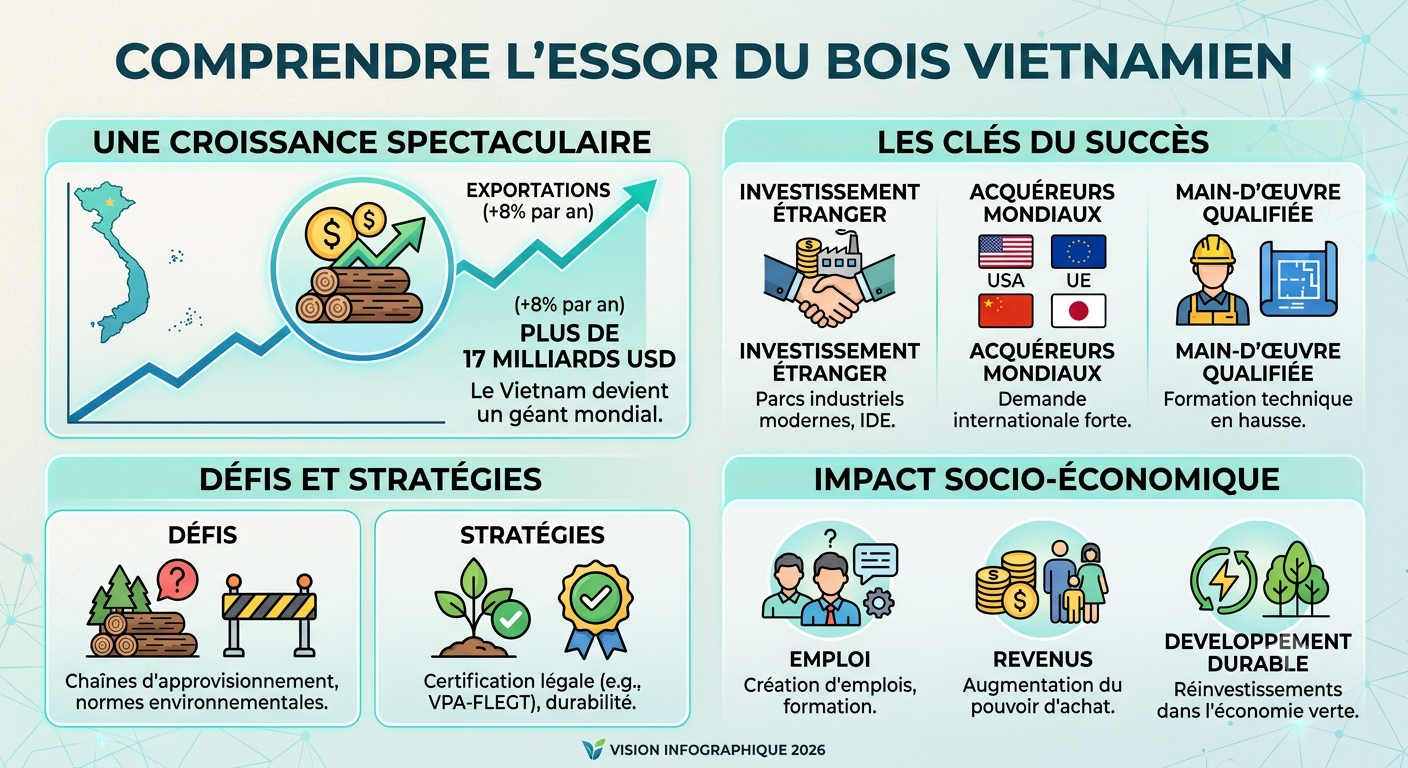
Why Cabinets Are the Most Illustrative Sector?
Kitchen cabinets crystallize the China-to-Vietnam migration better than any other furniture segment.
Tariff depth. Cabinets carry the deepest tariff stack on China (>275% combined). Other furniture categories face Section 232 alone. Cabinets force the decision.
Production capability. Vietnamese factories now run Homag, SCM, Biesse, and Cefla CNC lines comparable to leading Chinese plants. The capability gap that existed in 2018 has closed.
US compliance. Cabinets require KCMA quality certification, CARB-2 formaldehyde standards, EPA TSCA Title VI documentation, and often FSC chain-of-custody. Vietnamese exporters have invested heavily in these certifications over three years. A KCMA-led certification regime since 2024 blocks transshipment of Chinese cabinet parts through Vietnam.
Workforce. Vietnam's wood industry employs 600,000+ skilled workers (Forest Economic Advisors, November 2025), with factory wages averaging US$321/month vs $500-800 in coastal China.
Vietnam kitchen cabinet manufacturers have gained significant traction among US buyers in 2025-2026. They combine the tariff advantage, the compliance certifications, and the production capacity that Chinese factories can no longer offer at competitive cost.
Beyond Vietnam: How the Asian Map Is Redrawing
Vietnam is the primary winner, but not the only one.
Mexico offers USMCA duty-free access for many furniture categories, but cabinets are not exempt from Section 232. Labor cost ($5.56/hr per Tetakawi 2026) is roughly 3x Vietnam's hourly rate. Mexico wins on lead time (15-25 days vs 30-45 from Vietnam) but loses on unit cost.
Indonesia and Malaysia fall under the same July 2024 KCMA-driven scope determination. Malaysian-origin cabinets with Chinese parts now face the same China AD rates.
Cambodia entered the top-10 US furniture supplier list in 2024 (+19% YoY, $382M) but lacks cabinet-specific factory scale.
India is emerging but starts from a low base on kitchen cabinets.
A practical 2026 strategy: Vietnam for cabinets and case goods (primary), Mexico for upholstered furniture with USMCA benefits, China retained only for niche SKUs.
Logistics and Compliance Realities
The China-to-Vietnam shift creates new operational pressure points.
Port congestion. Cat Lai port introduced new drop-off rules in June 2025 (max 3 days before vessel ETA). Buyers without local logistics partners lose 7-14 days on poorly-scheduled shipments.
Tet (Lunar New Year). Vietnamese factories close 7-10 days in mid-February. Orders need to clear the factory before Tet eve or wait until March.
EUDR (December 30, 2026). Vietnam was classified low-risk in May 2025, meaning only ~1% of shipments face inspection. More competitive than Indonesia or Malaysia (standard-risk) for EU-bound wood products.
Certificate fraud. Counterfeit KCMA/CARB/FSC certificates have proliferated. Verify certificate numbers directly with issuing bodies, not via screenshots.
Most of these are easier to manage with someone local. Buyers without their own Vietnam office often hand them to a sourcing agent, Primo Sourcing, for instance, runs the factory vetting, in-production checks and customs paperwork from Ho Chi Minh City.
What to Watch in 2026-2027
The Section 232 escalation on January 1, 2027. A US-Vietnam trade framework deal could reduce this rate similar to UK (10%) or EU/Japan (15%). Track White House proclamations and Federal Register notices.
Vietnam wage trajectory. Region 1 minimum wage rose to VND 5.31M ($203) on January 1, 2026. Sustained 6-8% annual wage growth would compress Vietnam's cost advantage by 2028.
Indonesia and India scaling. Both are investing in cabinet-grade CNC capacity. By 2027, a 4-country Asian sourcing map may replace today's 2-country reality.
For now, the answer is clear. For US buyers in cabinets and most wooden furniture categories, Vietnam in 2026 offers the lowest combined cost-and-risk profile in Asia. The migration is not a hedge anymore. It is the baseline.